
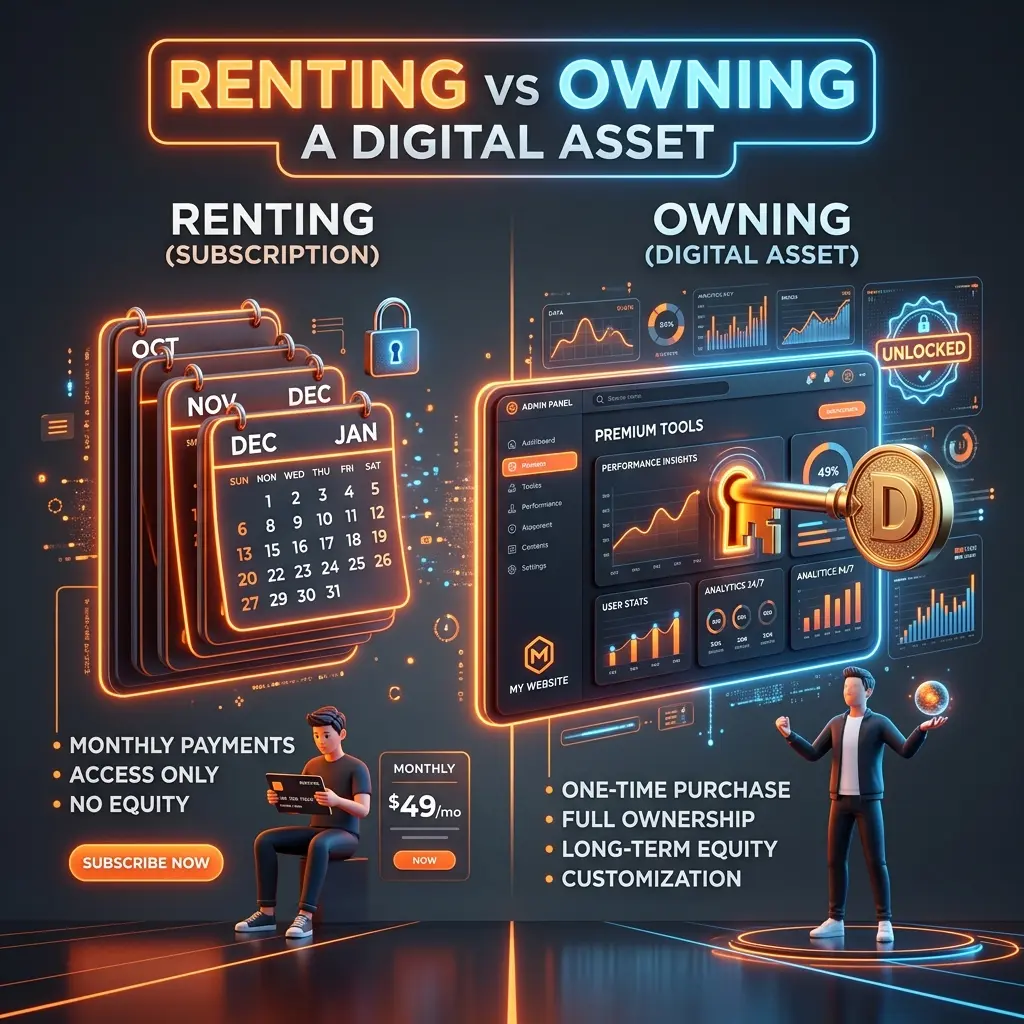
When you rent an office, you pay monthly for the right to use it. When you buy one, the upfront investment is larger — but then it is yours. Nobody can raise the rent. Nobody can evict you. An asset, not an expense.
An online store is no different. And yet most business owners treat it like a utility — something for which a monthly bill simply arrives, without stopping to ask whether those payments are building anything they own.
SaaS platforms like Shopify are built precisely on this mindset. They offer an easy start in exchange for a permanent subscription. And with every passing year — with every euro your turnover grows — the equation shifts further against you.
What You Actually Buy With the Monthly Subscription
When you pay 79 EUR a month for Shopify, you are not buying anything. You are buying the right to use their infrastructure for the next 30 days. Stop paying and the store disappears. The assets built there — the design, the customisations, the way things work — are not yours. They live on their infrastructure, under their rules.
When you invest in a PrestaShop store built to order, you buy something different: a digital asset you own outright. The code is yours. The data is yours. The design is yours. You host it wherever you choose, update it whenever you decide, and sell your business along with it should you ever decide to.
The difference is not technical. It is financial and strategic.
The Maths Nobody Shows You Upfront
Let us make the calculation concrete. A realistic scenario: a store with a turnover starting at 5,000 EUR per month and growing to 20,000 EUR per month over three years.
Shopify Advanced (0.5% transaction fee)
| Period | Monthly turnover | Subscription | Transaction fee | Monthly total |
|---|---|---|---|---|
| Year 1 | 5,000 EUR | 299 EUR | 25 EUR | 324 EUR |
| Year 2 | 10,000 EUR | 299 EUR | 50 EUR | 349 EUR |
| Year 3 | 20,000 EUR | 299 EUR | 100 EUR | 399 EUR |
Total paid to Shopify over those three years: approximately 13,700 EUR. Without a single euro going towards anything you own.
PrestaShop
| Cost | |
|---|---|
| Store development | 3,000 – 8,000 EUR (one-off) |
| Hosting (36 months) | ~1,300 EUR |
| Modules and maintenance | ~1,500 EUR |
| Total over 3 years | ~5,800 – 10,800 EUR |
At comparable or lower costs over three years, you own a built digital asset. Shopify offers nothing equivalent — only another invoice for next month.
And this is a conservative example. With higher turnover or a higher transaction fee (2% on the Basic plan), the difference becomes dramatic.
The Costs That Do Not Appear in the Advertising
The subscription and transaction fees are only the visible part. SaaS platforms carry a number of additional costs rarely mentioned at the start.
Applications. Much of the functionality that is built into PrestaShop or achievable with a one-off module requires a monthly application subscription on Shopify. Email marketing integration, a loyalty programme, advanced search, B2B functionality — each is a separate subscription. The real cost of applications for an average store reaches 100–300 EUR per month.
Design and functionality changes. With PrestaShop, a custom change is a one-off development cost. With Shopify, non-standard functionality may require an expensive application, Liquid workarounds, or may simply be impossible.
The price of growth. With Shopify you become a more expensive customer with every sale. With PrestaShop your growth costs nobody but yourself.
Vendor Lock-In: The Trap That Gets Harder to Leave
Three years into running a Shopify store, changing platform is painful. The design was built in Liquid — it is not portable. The customisations live in applications — they disappear with the account. Data can be partially exported, but the structure and logic cannot.
Shopify knows this. That is why it can raise prices. That is why it can change terms. You are tied in — not because switching is impossible, but because the cost of doing so grows with every year spent on the platform.
With PrestaShop no such dependency exists. The code is standard PHP. The database is MySQL. The hosting is standard. If you decide to change your hosting provider, your agency or even your platform in the future — everything is yours and portable.
"But PrestaShop Requires a Developer"
True. And this is not a drawback — it is a description of reality for any serious online business.
Shopify appears not to require a developer — until you need something non-standard. At that point it requires a specialist in Liquid and the Shopify API, whose services are no cheaper than a PrestaShop developer and whose output is more constrained.
The difference is this: with PrestaShop you pay a developer to build something that is yours. With Shopify you pay a developer to work within the constraints of someone else's platform — and the platform still takes its share.
A PrestaShop Store as a Digital Asset
When you build a business, you build assets. A physical store, a warehouse, equipment, a brand, a customer base. Your online store belongs in the same list — not in the list of operating expenses.
A well-built PrestaShop store has value. If you sell your business, it forms part of the valuation. If you attract investment, it demonstrates built infrastructure. If you seek financing, it is an asset.
A Shopify account is not an asset. It is a subscription, cancellable at the first missed payment.
When SaaS Makes Sense
Honesty requires acknowledging there are cases where a SaaS platform is a sensible choice. For a startup with a limited budget and a need to be live quickly, Shopify's short-term advantages are real. You do not deal with hosting, technical problems or development.
The problem is that many businesses start with this logic and never revisit the decision as they grow. They remain on the SaaS platform by inertia — and continue paying an increasing price for something they do not own.
If you are already in this situation, we have a dedicated article comparing PrestaShop, WooCommerce and Shopify in detail, including concrete calculations across different turnover scenarios.
Conclusion: Invest in Something That Is Yours
Every euro paid to Shopify as a subscription is a euro paid in rent. It builds nothing you own, does not increase the value of your business and does not give you greater freedom over time — on the contrary, the dependency grows.
Investing in a built PrestaShop store is different. It is a one-off investment that creates an asset you own outright, and the only recurring cost thereafter is hosting.
We build PrestaShop stores to order — from scratch to a full production solution, including ERP integrations, custom logic and design that reflects your brand. Nothing off-the-shelf, nothing from a template.
Contact us and we will calculate together the real value of owning your store compared with your current solution.
Sources
- Shopify — Pricing plans, official page, 2026
- Shopify Help Center — Transaction fees, 2026
- PrestaShop — Total Cost of Ownership, official site
- Gartner — Total Cost of Ownership for eCommerce platforms, 2024
- Forrester Research — Build vs. Buy in eCommerce Infrastructure, 2023